Central Vietnam, a narrow stretch of land framed by mountains and sea, has long been…
Not far from the expanding skyline of Da Nang, where glass towers rise and coastal roads stretch steadily along the sea, there exists a landscape that seems to follow a different logic altogether. The Sơn Trà Peninsula extends quietly into the East Sea, its dense forests and winding paths forming what is, in many respects, one of the last intact ecosystems of its kind in central Vietnam.
Its proximity to the city is, at first, what makes it remarkable. Within minutes, one can leave behind the rhythms of urban life and enter a space where the air thickens, the sounds soften, and the pace of movement slows almost involuntarily. Yet this closeness is also what renders Sơn Trà increasingly fragile. It exists not in isolation, but at the edge of rapid transformation.
To describe Sơn Trà simply as a destination would be to misunderstand its nature. It is less a place to visit than a system to be observed—an intricate balance of vegetation, climate, and wildlife that has evolved over time with little interruption. The forest canopy, dense and layered, does not reveal itself easily. What appears at first as stillness gradually unfolds into a network of subtle movements, each dependent on the other.
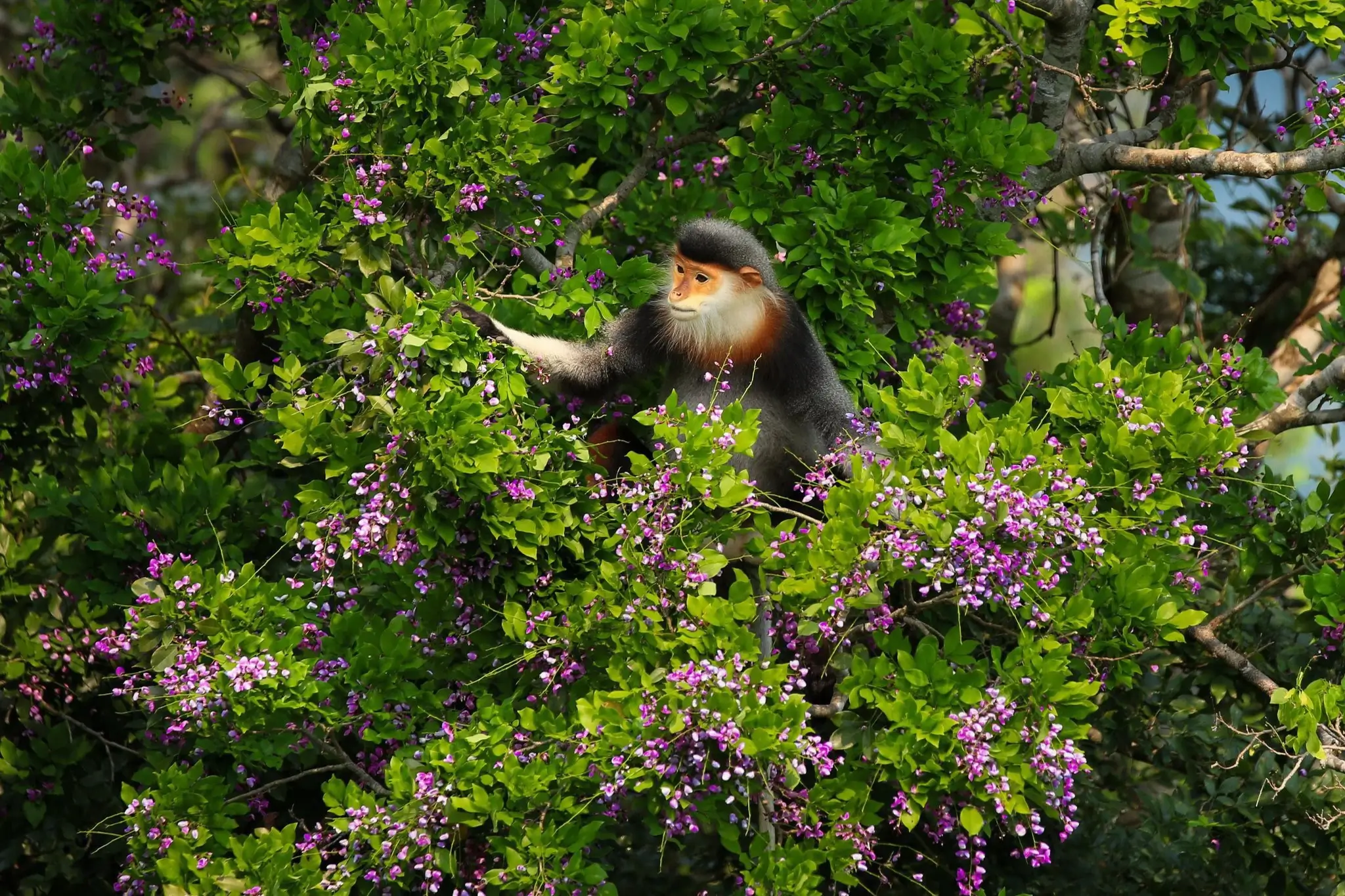
Among these, one presence stands apart, not because it dominates the landscape, but because it embodies its vulnerability. The red-shanked douc—often described as one of the most visually striking primates in the world—inhabits these forests with a quiet, almost elusive grace. Its coloration, at once vivid and improbable, gives it an appearance that seems nearly unreal. And yet, its survival is tied entirely to conditions that are increasingly uncertain.
Unlike species that adapt readily to change, the red-shanked douc depends on continuity. Its diet, its movement, and its social structure are all closely linked to the integrity of the forest. Even minor disruptions—noise, fragmentation of habitat, the steady encroachment of human activity—can alter patterns that have remained stable for generations. What makes the species remarkable is not only its rarity, but the degree to which it reflects the health of the environment it inhabits.
This is where the quiet tension of Sơn Trà becomes most apparent. Development, in various forms, continues to approach the peninsula. Roads improve access, tourism expands its reach, and the presence of the city presses ever closer. None of these changes are inherently unusual; they reflect broader patterns seen across much of the region. Yet within Sơn Trà, their impact carries a different weight.
The question is not simply whether development will occur, but whether a landscape such as this can absorb it without losing the very qualities that make it significant. Conservation, in this context, is not an abstract ideal but a practical dilemma—one that involves trade-offs not always visible at the surface.
For the visitor, this tension is not always immediately evident. The forest remains, the views are uninterrupted, and the experience, at least in its visible form, appears unchanged. But what is less apparent is often more consequential. The absence of disturbance is not the same as resilience, and what persists today does not necessarily guarantee what will remain tomorrow.
In this sense, Sơn Trà challenges a certain expectation of travel. It does not offer itself easily, nor does it conform to the logic of consumption that defines many destinations. To move through it is not to “see everything,” but to recognize that much of its value lies in what cannot be fully accessed or understood at once.
The presence of the red-shanked douc reinforces this understanding. To encounter it, even briefly, is not simply to observe a rare species, but to become aware of the conditions that allow such a species to exist at all. It is a reminder that rarity is often inseparable from fragility.
In a broader context, this reframes the notion of value in travel. Luxury, as it is commonly defined, tends to emphasize comfort, exclusivity, and control. Yet places like Sơn Trà suggest a different interpretation—one in which value is derived not from what is provided, but from what remains unaltered. To witness something that has not yet been diminished, to experience an environment that still retains its internal balance, is, increasingly, a rare privilege.
This does not imply urgency in the conventional sense, nor does it call for alarm. Rather, it invites a different kind of attention—one that is measured, restrained, and aware of its own impact. To visit Sơn Trà is not simply to arrive, but to participate, however briefly, in a landscape that does not exist for the purpose of being seen.
As development continues to reshape the edges of the peninsula, its future remains uncertain, though not yet decided. What endures, for now, is a delicate equilibrium—one that cannot be assumed, only recognized.
And perhaps that is where its significance ultimately lies. Not in what it offers, but in what it asks: that it be approached not as a destination to be consumed, but as a presence to be understood—before the conditions that sustain it begin, quietly, to disappear.
Related Posts