
Central Vietnam, a narrow stretch of land framed by mountains and sea, has long been…

There is a particular assumption that shapes much of modern travel: that a place, no matter how complex, can be understood within the limits of a well-constructed itinerary. With enough planning, enough information, and enough efficiency, a destination can be reduced to a sequence of highlights—seen, experienced, and ultimately, completed.
Central Vietnam resists this assumption.
At first glance, the region appears manageable. Distances are relatively short. The route from Huế to Hội An, often passing through Đà Nẵng, can be covered in a matter of hours. To the modern traveler, it presents itself as an efficient corridor—one that seems entirely possible to explore within a few days.
And yet, this apparent simplicity is precisely what makes the region easy to misunderstand.
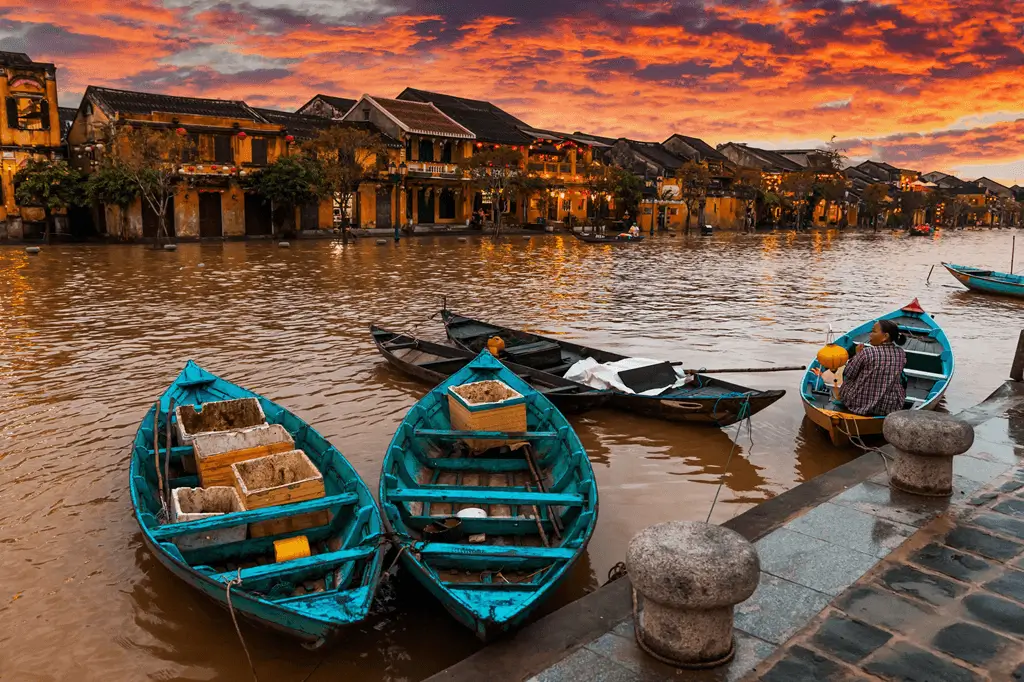
What unfolds across Central Vietnam is not a single narrative, but a convergence of histories, each unfolding at its own pace. In Huế, the legacy of imperial rule lingers not only in architecture, but in a sensibility shaped by restraint, hierarchy, and a certain quiet introspection. Further south, Hội An tells a different story—one of movement, exchange, and a past defined as much by merchants and travelers as by rulers and institutions.
Even within these places, meaning does not reveal itself immediately. It resides in details that are easily overlooked: the rhythm of daily life along a riverbank, the subdued atmosphere of a courtyard at dawn, the way a city changes character between morning and evening. These are not experiences that can be scheduled with precision. They require time—not simply to be seen, but to be absorbed.
This is where the idea of a “complete journey” begins to unravel. To move quickly from one landmark to another is to encounter surfaces. To remain, even briefly, is to begin to perceive depth. The difference is not one of distance, but of attention.
There is also the question of history, which in this region does not present itself as a singular, linear account. Layers of influence—indigenous, regional, and external—continue to shape how places are experienced today. The remnants of older civilizations, the imprint of imperial structures, and the transformations of the modern era coexist within the same landscape. To grasp this complexity in a single visit would require not just time, but a form of engagement that few itineraries are designed to allow.
Modern travel, however, is often structured around efficiency. It rewards movement, variety, and the accumulation of experiences. In such a framework, depth becomes secondary—something that is acknowledged, but rarely pursued. Central Vietnam challenges this model not by offering less, but by offering more than can be readily contained.
To experience the region meaningfully is, in a sense, to accept incompleteness. A first journey may reveal its visual character—its cities, its landmarks, its immediate atmosphere. A second may begin to uncover its historical and cultural layers. A third, perhaps, allows for a more personal connection, shaped less by discovery and more by familiarity.
This is not a limitation, but a different kind of value. It suggests that a place does not need to be exhausted in order to be appreciated. On the contrary, what remains unseen often becomes the reason to return.
In a time when travel is increasingly measured by coverage—how much has been visited, how efficiently it has been done—Central Vietnam offers a quieter proposition. It cannot be fully experienced in a single journey, not because it is inaccessible, but because it is layered. And what is layered does not reveal itself all at once.
To return, then, is not to repeat the same journey, but to continue it.
Related Posts


Comments (0)